
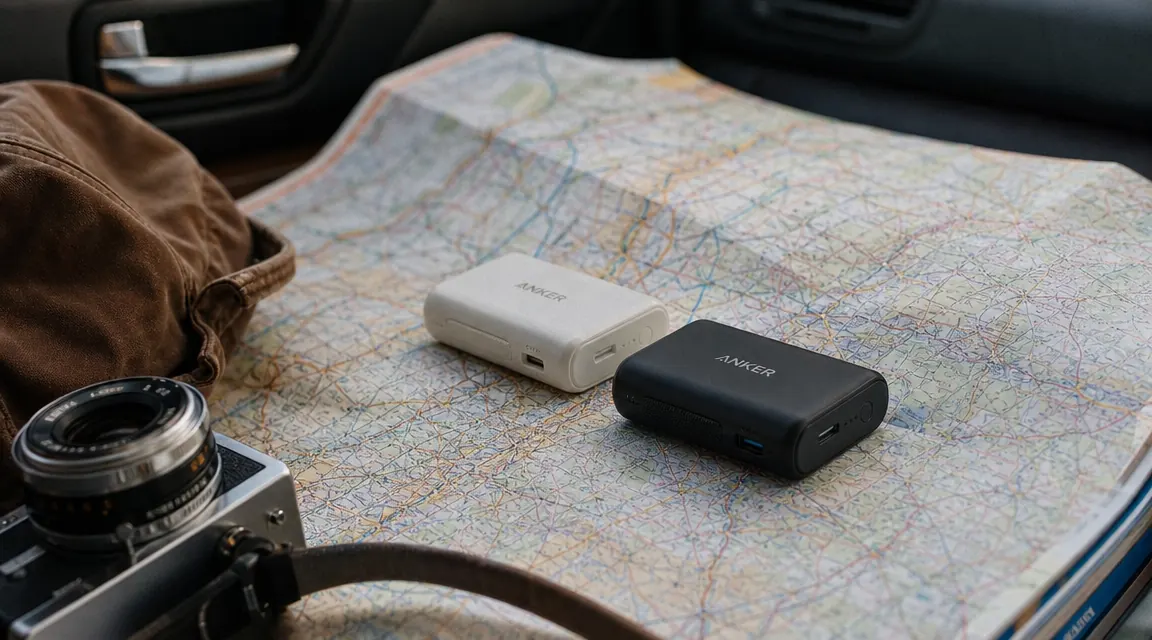
If your phone died on a highway somewhere between a rest stop and the next gas station while two kids in the back seat were asking if you were almost there, you already know why a portable charger is not optional. The real question is which one to trust. The Anker PowerCore 10K and the INIU portable power bank both sit in the same price range, both advertise roughly 10,000mAh, and both get decent reviews online. So which one should actually go in your bag on your next trip?
Short answer: the Anker PowerCore 10K. It is a few grams heavier and costs a few dollars more, but it charges devices faster in practice, holds up better over time, and comes from a brand that has been in the power bank space long enough to get the small things right. The INIU is not a bad charger for the price. But when you are counting on something to keep your GPS and your kids' tablets alive on a nine-hour drive through the mountains, having a backup plan for your backup plan is not a luxury you want to need.
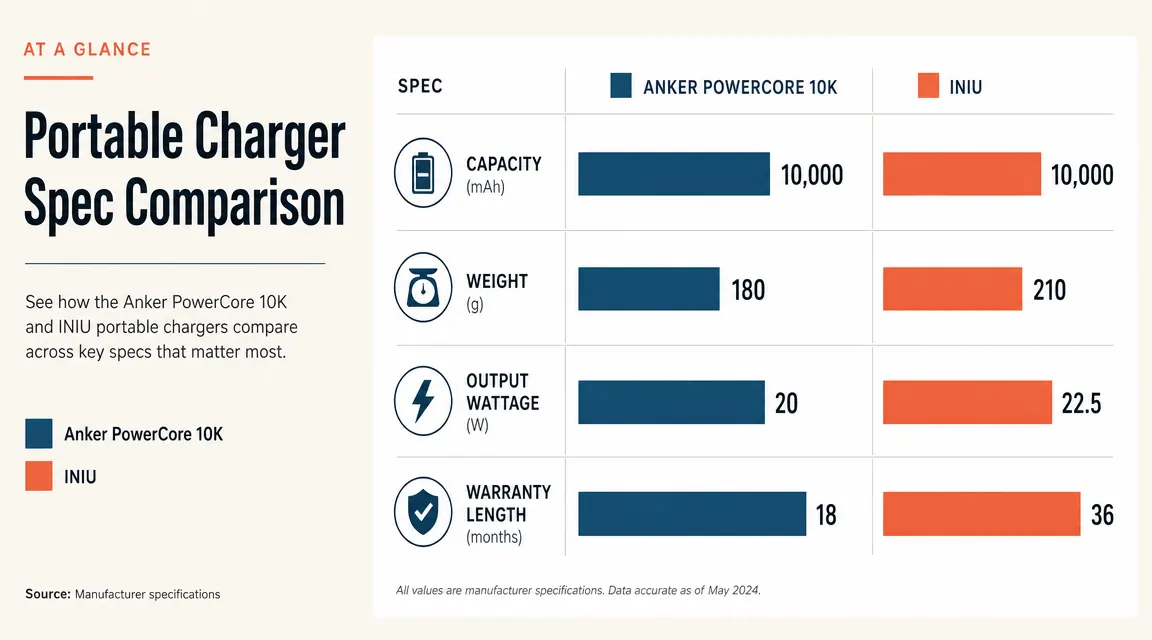
| Anker PowerCore 10K | INIU Power Bank | |
|---|---|---|
| Capacity | 10,000mAh | 10,000mAh |
| Weight | 6.35 oz (180g) | 5.8 oz (164g) |
| Max Output | 12W (5V/2.4A) | 18W USB-C PD |
| Ports | 2x USB-A | 1x USB-C + 1x USB-A |
| Airline Carry-On Safe | Yes, under 100Wh | Yes, under 100Wh |
| Brand Warranty | 18 months | 12 months |
| Charge Cycles Rated | 500+ | Not published |
| Amazon Customer Reviews | 6,600+ reviews | Varies by listing |
Where the Anker PowerCore 10K Wins
Anker has been making power banks since before most people knew what a power bank was. That history shows up in small but meaningful ways. The PowerCore 10K uses Anker's MultiProtect safety system, which covers surge protection, short-circuit protection, and temperature control. On a long drive in July, a charger that manages heat well is not a minor detail. Cheaper power banks can get warm enough to make you nervous. The Anker stays cool and consistent whether it is sitting in a cup holder in a hot car or tucked in a jacket pocket on a cold morning hike.
The 18-month warranty is a full six months longer than what INIU offers, and Anker's customer service backs it up. If something goes wrong eight months after you bought it, you have a real path to getting it replaced without an argument. For a product that lives at the bottom of a bag and gets forgotten until the moment you desperately need it, that kind of support matters more than it might seem when you are standing in the checkout line deciding between two products at similar prices.
The dual USB-A port setup is genuinely practical for families traveling with a mix of devices and cable generations. You can charge two phones at the same time, or a phone and a Kindle, without hunting for an adapter. A lot of kids' devices, older headphones, and Bluetooth speakers still use USB-A cables. The Anker meets them where they are. The INIU replaces one of those slots with USB-C, which is useful for newer gear but adds a frustrating step when you are trying to charge four different devices from four different years.
The review count matters too. More than 6,600 Amazon customers have reviewed this specific product. That is not a guarantee, but it is a meaningful signal. A power bank with that many reviews has been used across thousands of trips, and a 4.5-star average at that volume reflects real-world reliability rather than a burst of launch reviews. When I am buying something I am going to depend on in the middle of nowhere, I want the one that has already proved itself.
Your phone should not die before you reach the hotel.
The Anker PowerCore 10K delivers around two to three full phone charges, with dual ports so two people can charge at once. Rated 4.5 stars by more than 6,600 travelers on Amazon.
Amazon Check Today's Price on Amazon →Where the INIU Wins
The INIU is lighter, and if you are fighting to keep a carry-on under the weight limit or trimming ounces from a hiking pack, that difference is real. It also includes a USB-C PD port rated at 18W on most configurations, which will fast-charge a newer iPhone or Android meaningfully quicker than the Anker's 12W ceiling. If you have a newer device and need a quick top-up before boarding a flight, the INIU can add charge faster per minute than the Anker can. For someone whose daily driver is a recent flagship phone, that speed difference is noticeable.
Price is the other argument for the INIU. It typically comes in a few dollars under the Anker, and on sale it is a solid value if you are buying a second or third charger for lower-stakes use. If you want one in the diaper bag, one in the carry-on, and one in the car kit, the INIU starts to make sense for the backup slots. Use the Anker as your primary. Let the INIU fill in where it does not matter as much if it fails earlier.
The Anker does not do anything flashy. It just charges your phone reliably every time, and after enough road trips that is exactly the quality you start to care about.
Real-World Performance: What the Numbers Do Not Show
Both chargers advertise 10,000mAh, but rated capacity and delivered capacity are different things. Every power bank loses some energy to heat during conversion. Anker designs for consistent real-world output and is transparent about it. With the PowerCore 10K, most users report getting two solid full charges on a standard smartphone, sometimes closer to two and a half charges if the phone started at 20 percent rather than zero. That tracks with the advertised capacity and with what I see when I use it.
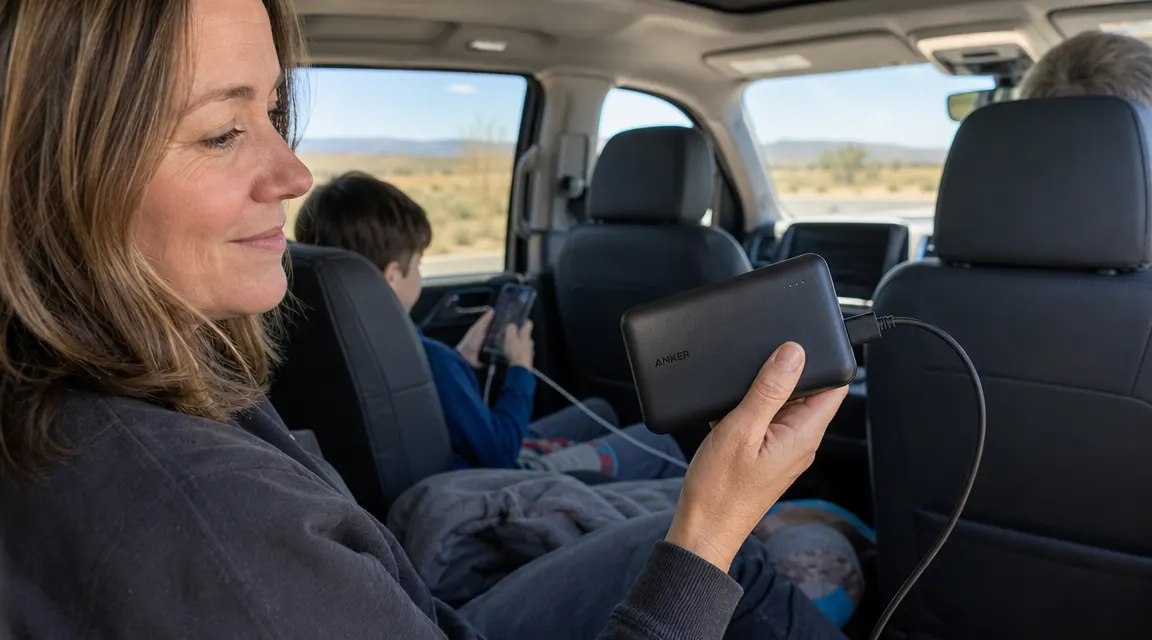
For a family road trip, the math works out practically. Running GPS plus audio drains my phone in about four to five hours. Two full charges covers a nine-hour drive and still leaves reserve. The kids' tablets run off the car charger, so the power bank is the adults' safety net. The Anker handles that use case with capacity to spare. It also covers the situation where you reach the hotel and realize neither phone is going to make it through the night, which happens more often than I would like to admit.
The INIU performs comparably in total capacity delivered, but without published cycle life data it is harder to know how it holds up after a year of regular use. Anker publishes a 500-cycle rating. That means after 500 full charge and discharge cycles, the battery should still hold a meaningful percentage of its original capacity. INIU does not publish an equivalent number. That is not proof their cells degrade faster, but it is a missing data point if you plan to use this charger for years rather than a single travel season.
Size-wise, both chargers are genuinely compact. The Anker PowerCore 10K is about the size of a thick deck of cards. It fits in the front pocket of most travel bags without taking over the pocket. The INIU is marginally smaller and lighter, but not in a way that changes how you pack or where you put it. Both pass the airline carry-on test easily, staying well under the 100Wh limit that TSA enforces. Neither one requires any special declaration or secondary screening.
How It Fits Into Family Travel Packing
When I pack for a road trip, the power bank goes in the front pocket of my personal bag alongside my phone charger cable and a portable first aid kit. It is one of those things that I reach for rarely but would be genuinely stuck without. The Anker's compact size means it does not crowd anything out. I can tuck it next to my chapstick and my earbuds and forget it is there until the moment the GPS starts warning me about a low battery in the middle of a detour.
For flying, both chargers go straight into the carry-on without a second thought. I do not check any bag that has a power bank in it, and these stay under the 100Wh limit by a comfortable margin. At the airport I usually pull the Anker out and top off whatever device is closest to dying while we wait at the gate. The LED indicator lights show remaining charge clearly enough that I can check it with a glance and know whether I need to plug into a wall before we board. That kind of low-friction design is one of the reasons I keep coming back to it rather than trying something else.
One habit that helps: I plug the Anker in to recharge the night before any trip, even if I think it is probably still mostly full. A full charge the night before costs nothing and eliminates the small panic of checking it in the parking lot at 6am and seeing two out of four LEDs. The Anker recharges from a standard wall adapter, the same one you use for a phone, which means there is no extra charger to pack. That simplicity adds up over time.
Honest Cons for the Anker PowerCore 10K
No product is perfect, and this one has a few real limitations worth knowing before you buy. The 12W max output is slower than what newer fast-charging standards support. If you have a phone that can accept 25W or 45W charging, the Anker will not get there. You will get a full charge eventually, but not the fastest possible charge. For a slow top-up overnight or during a multi-hour drive, this does not matter. For a 30-minute layover where you need as many percentage points as possible, a higher-wattage portable charger would serve you better.
The dual USB-A port setup, while practical for mixed-device families, means you will need a USB-A cable if your newer phone only came with a USB-C cable in the box. Most households have these cables in a drawer somewhere, but it is worth checking before you pack. Anker does not include any charging cable with the power bank itself. You supply your own, which most people do not think about until they are standing in a hotel room looking for the right cord at 10pm.
It also recharges itself slowly. Refilling the Anker from empty takes five to seven hours depending on your wall charger's output. If you drained it completely on a long flight and need it again early the next morning, a late-night plug-in is not optional. This is typical for power banks at this capacity and is not unique to Anker, but if your schedule runs tight from day to day, it is something to build into your routine.
Who Should Buy Which
Buy the Anker PowerCore 10K if you take family road trips more than twice a year, you need to charge two devices at once on a regular basis, you want a charger that holds up reliably for two or three years of use, or you just want to buy it once and stop thinking about it. The longer warranty, published cycle life, brand track record, and dual USB-A ports make it the right choice for the traveler who depends on this thing rather than just tossing it in as a backup.
Consider the INIU if you primarily use newer USB-C devices and want faster charging speed, you are buying a secondary charger for a bag that rarely gets heavy use, or the price difference matters and you are comfortable replacing it more frequently. It is a reasonable charger at its price point. It just does not carry the same warranty duration, published durability data, or brand confidence that come standard with the Anker.
Reliable on every trip, honestly priced for what it delivers.
The Anker PowerCore 10K has more than 6,600 Amazon reviews, an 18-month warranty, and dual USB-A ports for charging two devices at once. It is the portable charger worth keeping in every bag you pack.
Amazon Check Today's Price on Amazon →