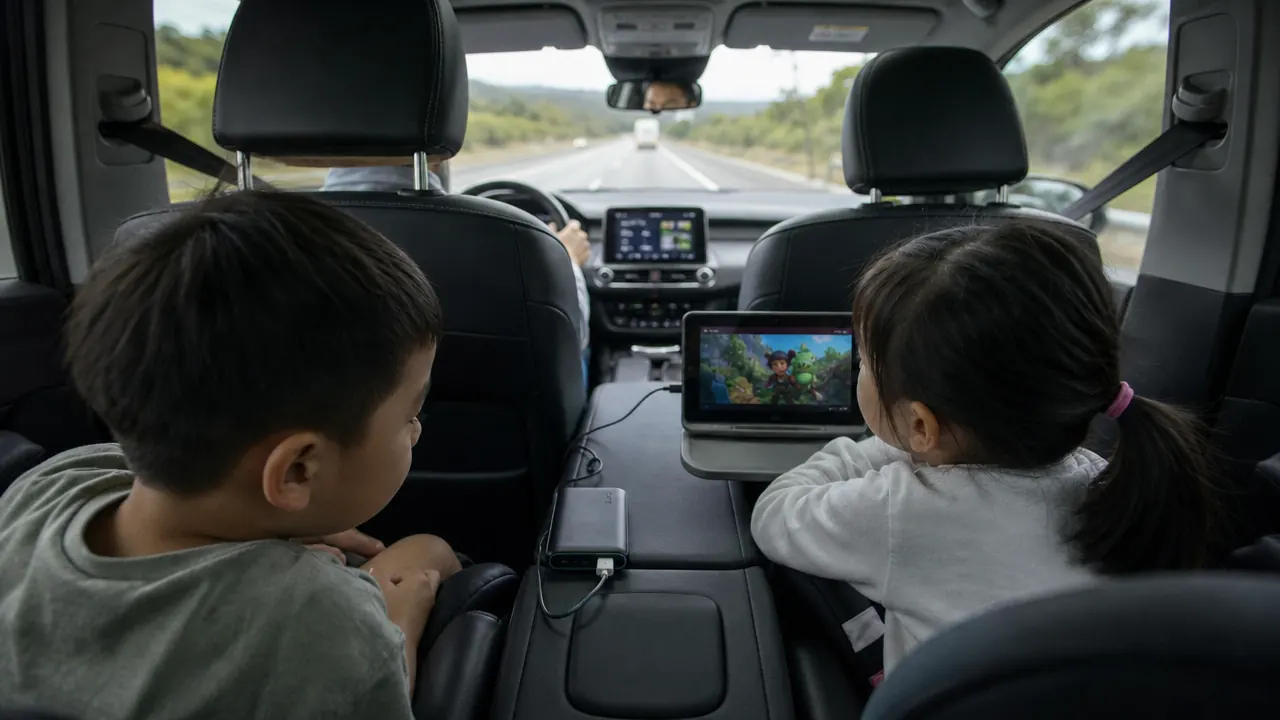

I learned about the importance of a portable charger the hard way, on a nine-hour drive to my sister's place in Tennessee with my two kids, ages seven and nine, somewhere around the Kentucky border. My son's tablet was at four percent. My daughter's was at two. My phone, which was also our GPS, sat at eleven percent. The car charger we owned at the time could only handle one device at a time, and the kids were already bickering over who got it first. That trip ended with both tablets dead for two hours and me navigating off-memory through three small towns. I told myself I was never doing that again.
That is when I started researching portable chargers seriously, and after reading through dozens of options, I landed on the Anker PowerCore 10K. I have been using it for almost two years now. It has been on six road trips, two flights, one county fair, and more than a few school pickup lines where I sat in my car with a nearly dead phone. This review is the long version of what I have learned about it.
Quick Verdict
A genuinely compact, reliable power bank that handles real family travel demands without drama. The charging speed is modest, not fast, but the size and dependability make it the one I reach for every single time.
Amazon Check Today's Price →Your phone should not be the thing that ruins a good trip.
The Anker PowerCore 10K is compact enough to drop in any bag and carries enough power to refill two phones from empty. Over 6,600 reviews, 4.5 stars, and it has been my backup for two years of family travel.
Amazon Check Today's Price on Amazon →How I Have Used It Over Two Years
The first real test was a flight out of Nashville with a two-hour layover in Charlotte. My husband and I were traveling with both kids and only one working outlet in our gate area, which another family grabbed before we even sat down. My daughter wanted to watch a show, my son needed to finish a reading assignment on his school tablet, and I was trying to sort out a delayed connecting flight on my phone. The Anker was already in my bag. I pulled it out, plugged my daughter in first, then ran a second cable to my son's tablet. By the time we boarded, both devices were back above sixty percent and my phone had not dropped below the level I started at.
On road trips, I keep it in the front cup holder or tucked in the door pocket. It is about the size of a deck of cards, maybe a little thicker. It does not roll around or feel like clutter. I charge it the night before we leave and it is ready for the whole day. On our last long drive, which was eleven hours to visit family in Texas, the kids cycled through it twice and my phone stayed charged the entire trip without ever needing the car charger. That kind of reliability is what I pay attention to now.
I also keep one in my personal carry-on full-time now, not just when I travel with the kids. When I flew out alone for my sister's bachelorette weekend, I used it at the airport, on the plane, and at a concert where the charging stations had lines forty people deep. It is just something I stopped thinking twice about bringing.
What Is Actually Inside: Capacity, Ports, and What That Means Day-to-Day
The PowerCore 10K holds 10,000 milliamp hours. In practical terms, that is roughly two and a half full charges for a modern iPhone or about two full charges for a Samsung Galaxy. For tablets with larger batteries, you are looking at one charge and a significant top-up, sometimes a bit more depending on how drained the device starts. Anker rates it at delivering about 10 watts of output through the USB-A port and up to 18 watts through the USB-C port with their PowerIQ technology. That is not blazing-fast charging by current standards, but it is solid and consistent.
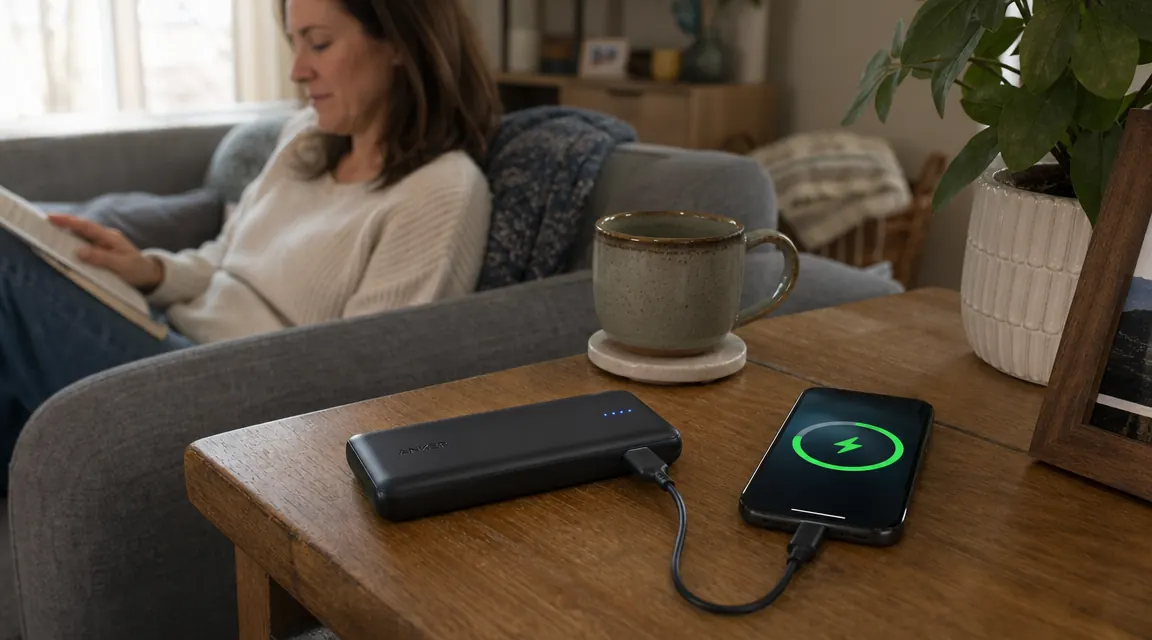
The unit I have has two output ports: one USB-A and one USB-C. That means I can charge two devices at the same time, which matters a lot with kids involved. The LED indicator on the side shows four dots representing the charge level. Each dot is roughly twenty-five percent of capacity. It is simple and accurate enough that I always know whether I need to top it off the night before a trip. Recharging the bank itself takes about four hours from empty using the included cable.
The body is a matte black plastic that does not pick up fingerprints or feel cheap in the hand. It weighs 6.7 ounces, which I notice less than I notice it not being there. It cleared TSA security on every flight I have taken it on with zero questions, which is exactly what I want from travel gear.
Performance Over Time: What Two Years of Real Use Looks Like
I want to be straightforward here, because I have seen other reviews talk about portable chargers like they never wear down. Mine has. After roughly two years of regular use, I would estimate I am getting about eighty to eighty-five percent of the original capacity. The four indicator lights still function accurately, but I notice that two charges worth of work used to leave me with one light still glowing, and now I am closer to empty after the same amount. It is a gradual decline and I expected it. Lithium-ion batteries cycle down over time. For a charger I have used on this many trips, the degradation is completely normal.
What has not changed is the reliability. It has never failed to turn on, never gotten hot in a way that felt concerning, and never had the cable connection issues I have seen with cheaper no-name banks where the port loosens after six months. The build quality genuinely holds up, which is not something I can say about every piece of travel gear I have owned.
After two years and more road trips than I can count, the Anker has never once let me down when I needed it. That kind of dependability is worth more than any spec sheet.
The Tradeoffs: What the Anker PowerCore 10K Does Not Do
Charging speed is the main thing I would flag. If you have a phone that supports 25-watt or 45-watt fast charging, this charger will not use any of that. At 18 watts through the USB-C port, it is noticeably slower than plugging into a wall with a good brick. On a long flight where I was trying to go from thirty percent to full, it took close to two hours. That is fine when you are sitting still, but if you are on a short layover and need a quick top-up, it does not sprint the way some newer chargers do.
The other limitation worth mentioning is that this charger does not support wireless charging. You need a cable. For most people that is not a problem, but if you are someone who depends on wireless charging pads and never keeps cables in your bag, factor that in. I keep a short USB-C cable and a short Lightning cable in a small pouch in my bag at all times, so it has never been an issue for me.
There is also no wall adapter included in the box. You get the charging cable and the bank itself. If you need to buy a wall brick separately, that is an added cost. I already had one, so it did not bother me, but it is worth knowing upfront.
Pros
- Compact enough to fit in a jacket pocket or small purse without adding noticeable bulk
- Two ports let you charge two devices simultaneously, which is genuinely useful with kids
- Consistent, reliable performance across two years of real family travel use
- TSA-friendly with no issues at security on any flight
- Solid build quality with no port loosening or plastic cracking over time
- 4.5-star rating across more than 6,600 reviews backs up the real-world reliability
Cons
- Charging speed is modest, not fast charging by current standards
- No wireless charging support, cables are required
- No wall adapter included in the box
- Battery capacity degrades over two-plus years of heavy use, as expected with lithium-ion
How It Compares to What I Tried Before
Before the Anker, I had a no-brand 10,000mAh bank I found on a deals site for about twelve dollars. It worked fine for the first four months and then started cutting out mid-charge, only delivering a partial charge before shutting off on its own. I also tried a smaller 5,000mAh option from another brand that was genuinely pocketable, but the capacity was not enough for a full day of travel with two kids draining devices constantly.
The Anker sits in a sweet spot. It is not the smallest option on the market and it is not the fastest, but it is consistent in a way the cheaper alternatives were not. Anker has an 18-month warranty, which I have never needed but appreciate having. For a product you are relying on in the middle of travel, the peace of mind from a real brand with real customer support matters to me more than shaving a few dollars off the price.

Who This Is For
This charger is the right fit for families who travel by car or fly a few times a year and need a dependable backup for phones and tablets. If you are packing for a road trip with kids and you want something that will keep devices alive through a long day without thinking twice about it, the Anker PowerCore 10K handles that job well. It is also a great fit for solo travelers who want a no-fuss charger they can drop into a carry-on and forget about until they need it. If your main goal is reliability at a reasonable price, this is a clear choice.
Who Should Skip It
If you are a frequent business traveler with a flagship phone that supports 45-watt fast charging and you need to go from zero to full in thirty minutes at an airport, this is not your charger. You would be better served by a 20,000mAh or higher-capacity bank with a 65-watt PD output, though you will pay considerably more and carry more weight. If you are also a strictly wireless-charging household and never keep cables in your bag, the lack of Qi support will be a friction point. And if you are a solo traveler who only needs to top off one phone occasionally, the smaller 5,000mAh version of this same Anker line might be all you need and is even more compact.
For the rest of us, the people driving to grandma's house with two kids in the back and one phone doing GPS duty while the other keeps everyone calm, the PowerCore 10K does exactly what it is supposed to do, every single time.
Two years, six road trips, and it has never let me down.
The Anker PowerCore 10K runs around $25.99, charges two devices at once, and is compact enough to toss in any bag. If you want one thing in your travel kit that just works, this is it.
Amazon Check Today's Price on Amazon →