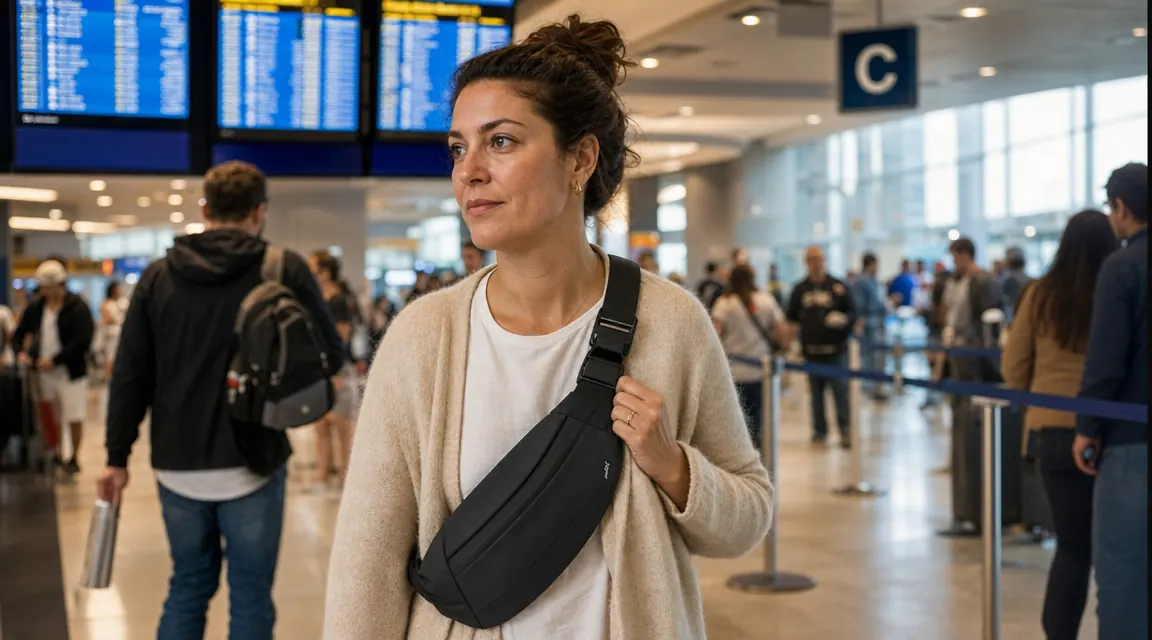
You know that feeling when you are standing in a packed security line at the airport, your passport and cards stuffed in a tote bag that is open at the top, and you glance around and realize you have no idea who is brushing past you? I used to do exactly that. I carried a soft tote, wallet technically in there somewhere, trusting that nobody would reach in. Then a woman I know got her credit card RFID-skimmed without anyone physically touching her purse. She did not find out until three weeks later when the charges showed up on her statement. After that, I switched to the SPAHER Anti-Theft RFID Sling Bag and started actually thinking through what I carry and how.
Airports concentrate the problem. You have hundreds of strangers pressed together in security lines, gate waiting areas, and baggage carousels. You are distracted by boarding passes, kids, and overhead announcements. Your hands are full. At least two things in your bag, your credit cards and your passport, can be read wirelessly by anyone with a cheap RFID reader if they get within a few feet. This guide walks through five concrete steps for protecting your valuables from the parking garage all the way to your seat, with the SPAHER bag as the recommended tool for each one.
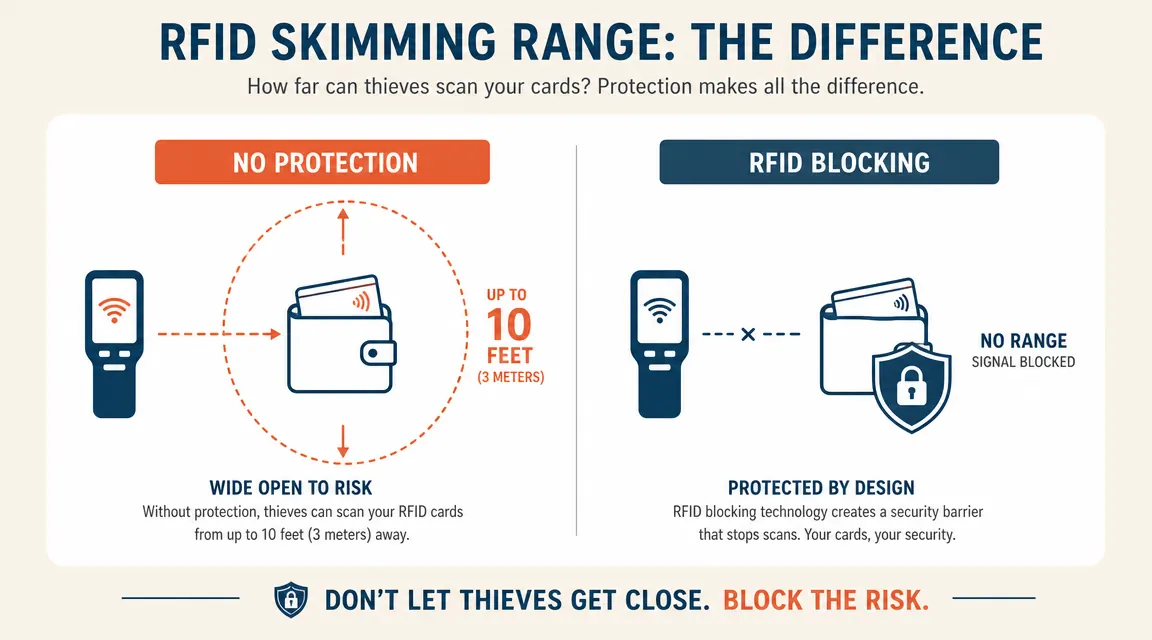
Your passport and credit cards are readable from three feet away unless you are carrying the right bag.
The SPAHER Anti-Theft Sling Bag has a hidden zipper pocket, RFID-blocking lining, and slash-resistant straps built for exactly this situation. Rated 4.5 stars from over 2,700 travelers.
Amazon Check Today's Price on Amazon →Why Airports Are a Pickpocket and Skimmer's Favorite Venue
Before the steps, it helps to understand what you are actually protecting against, because there are two separate threats and most people only think about one. The first is physical theft: someone unzipping your bag or lifting your wallet from a loose pocket while you are loading bins at the TSA belt or wrestling a stroller through a narrow gate area. The second is contactless skimming, where a device reads the NFC or RFID chip in your credit card or passport without touching anything. Both happen in airports. Both are preventable with the right setup.
Security lines are the highest-risk moment for physical theft because you are occupied, your bag is often behind you on a belt, and you are watching the X-ray screen. Baggage claim is second highest because the crowd is tired, distracted, and jostling. Boarding queues are third, particularly on budget carriers where overhead bin competition creates a lot of physical contact and bag repositioning. The steps below address each of these windows specifically.
Step 1: Put Your Documents and Cards in a Dedicated RFID-Blocking Compartment Before You Leave the Car
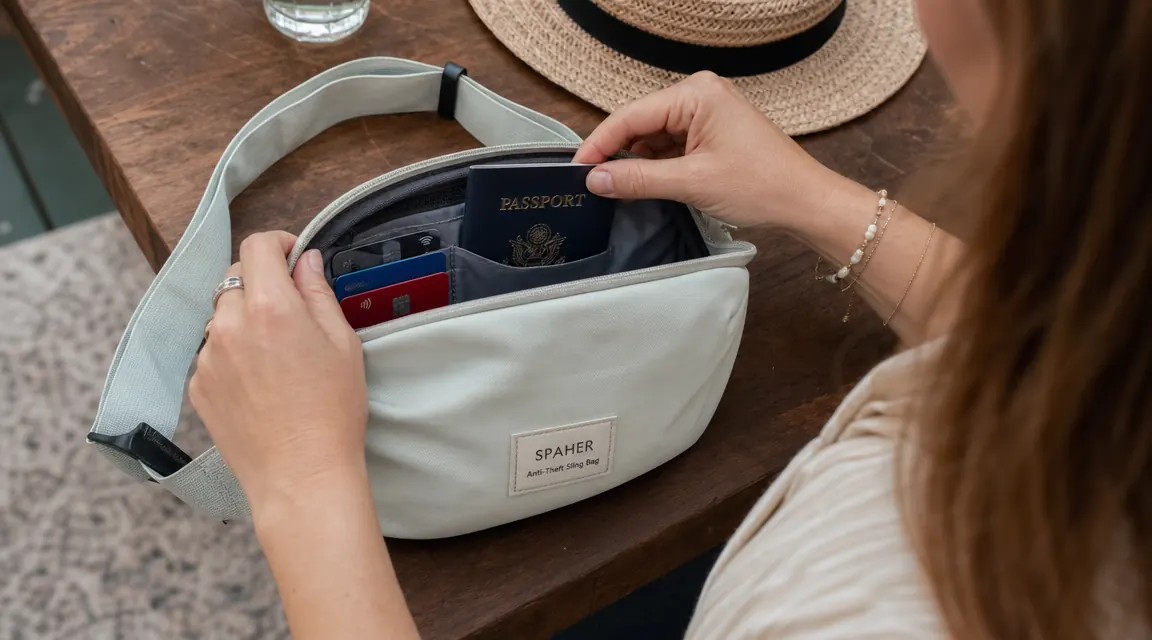
The single biggest mistake I see families make is treating passport and card organization as a security-line problem to solve in the moment. By the time you are in line, you are already in the high-risk zone. Transfer your passport, boarding passes, and the two cards you plan to use during travel into your RFID-blocking bag before you walk into the terminal. In the SPAHER bag, that means loading the hidden inner pocket, the one with the RFID-blocking lining, while you are still sitting in a parking space or at the curb.
The hidden pocket on the SPAHER sits against your body when the bag is worn correctly. It does not have an exterior zipper pull; you access it through the inside of the main compartment. That design means someone would have to unzip the bag, reach inside, and locate the internal pocket opening just to get to your documents. That is three steps versus the one step required to dip into an open tote. When everything is stowed before you enter the terminal, you do not have to reorganize in a crowd.
Leave your everyday debit card and any cards you are not using at home or deep in your checked bag. Travel with two cards maximum: one in the RFID pocket and one as a backup in a different bag. If your wallet gets compromised, you still have a way to pay.
Step 2: Wear the Bag Chest-Forward with the Main Zipper Facing Your Body
Sling bags are marketed as crossbody bags, and most people wear them with the bag resting on their back or hip, zippers facing out. That is the wrong configuration for a crowd. When the zipper faces away from your body, it is accessible to anyone behind or beside you. Wear the SPAHER bag rotated so it rests on your chest or front torso, with the zipper face pressed against you. You give up a little convenience since you have to rotate the bag to open it, but you eliminate the most common physical access point.
This adjustment also keeps the bag in your field of vision at all times. When it is on your back you cannot see it; you only know it is there by feel. When it sits on your chest you can see whether it has shifted, whether the zipper is moving, and whether someone is getting uncomfortably close. For families traveling with kids, this matters because you are often bending over, lifting, and turning in ways that move a hip or back bag outside your visual range without you noticing.
Step 3: Use the TSA Security Line as a Dry Run for Your Bag Routine
Security is the one moment when you have to separate from your bag, and it is the moment when most airport theft actually occurs. Before you reach the conveyor, move anything you need for the X-ray check, such as your laptop, liquids bag, and shoes, into a single bin that you place last on the belt. Your bag goes into a bin or directly on the belt second-to-last, so it exits the X-ray while you are still close to the output end. Do not put your bag first. If the line stalls or you get flagged for a secondary check, your bag can sit unattended at the output for several minutes.
Once through the scanner, grab your bag first, then everything else. Do not linger at the belt reorganizing. Pick up the bag, step to the side bench, and repack there. The SPAHER is compact enough to fit in a standard TSA bin and lightweight enough to grab quickly without fumbling.
If you are traveling with a child who needs a separate bin, one parent handles the kids' stuff and one parent keeps eyes on the bag bin. Split the task intentionally rather than assuming both adults are watching everything. This sounds obvious, but in practice the attention fractures and bags drift.
Step 4: Keep Your Phone in the Bag's Interior, Not in Your Back Pocket or Jacket
Phones are the most stolen item in airports, and they are almost always taken from accessible locations: back jeans pockets, outer jacket pockets, open tote side pockets, and jacket breast pockets. The pattern is distraction plus easy access. You look at the departures board, you set your bag down to tie a shoe, you turn to answer your kid's question. Your phone is gone in under three seconds.
The SPAHER has a dedicated phone pocket with its own zipper on the back panel. Use it. When your phone is zipped inside a crossbody bag worn against your chest, the sequence required to steal it is: touch the person, find the zipper, unzip, extract. That sequence takes time and makes noise, both of which are deterrents in a public space. Compare that to lifting a phone from a back pocket, which takes under a second and requires no sound.
The question is not whether someone could steal from you in a crowd. It is whether your setup makes you a five-second target or a thirty-second target. Thirty seconds is usually enough to make a thief move on.
Step 5: Use the Luggage Strap Pass-Through If You Have a Rolling Carry-On
The SPAHER sling bag has a luggage strap pass-through on the back panel that lets you slide it over the telescoping handle of a rolling carry-on. This is more of a convenience feature than a security feature, but it closes one specific vulnerability: the moment when you are managing a rolling bag and your sling bag slides off your shoulder or drifts to your side because your hands are full.
When the bag is threaded onto your roller handle, it stays upright and faces forward. You are not reaching back to reposition it. You do not set it down on the floor to rest your shoulder. It travels as one unit with your rolling bag, which keeps your hands free to manage kids, boarding passes, and overhead bins. At the gate, slide it off the handle and return it to chest-forward position before boarding.
One note: the luggage strap pass-through works best with handles between 1.5 and 2.5 inches wide. Most standard carry-on handles fall in that range. If you have an oversized bag with a very wide handle, check the fit before you rely on it.
What Else Helps Beyond the Bag
The bag is the anchor, but a few habits make the whole system work. First, book an aisle or window seat rather than middle when you have a choice. Middle seats mean two strangers have access to the space where your bag sits on the floor in front of you. Second, at your gate, sit with your back to a wall rather than in the center of an open seating area. This reduces the number of people who can approach from behind. Third, if you need to charge your phone at an airport outlet, keep the bag in your lap or looped over your arm rather than sitting on the floor beside you. Bags left on the floor have been grabbed in the seconds it takes a traveler to look up at a departing flight announcement.
For international travel specifically, consider saving a photo of your passport to a secure cloud folder you can access from any device. If the passport itself is lost or stolen, you will need this to work with the nearest embassy. Digital backup does not replace the physical document but it speeds up the replacement process. Keep the RFID-blocking pocket loaded with the real passport, and the backup lives only in your secure storage.
If you want to read more about the specific anti-theft features on this bag and how they hold up over time, the full breakdown is in our SPAHER anti-theft sling bag review. And if you are still deciding whether an anti-theft bag is worth carrying at all, 10 reasons to carry an anti-theft bag when you travel goes through the scenarios where it makes the biggest difference.
A Quick Word on What This Setup Does Not Do
No bag eliminates all risk, and it is worth being clear about the limits. RFID blocking protects the cards and passport that are inside the RFID-lined compartment. Cards you leave in a wallet in your jeans pocket are still exposed. The slash-resistant strap on the SPAHER resists cutting but does not make the strap unbreakable under force. If someone grabs the bag and runs, they may still get away with it depending on how you are wearing it. What the bag does is raise the cost and time of theft to a level that makes you a less attractive target than the person next to you with an open tote and a phone in their back pocket. That is a real and meaningful reduction in risk, not a guarantee.
The steps above work together. Wearing it chest-forward while also using the RFID pocket while also keeping your phone inside creates a layered situation that most opportunistic thieves will pass on entirely. Doing just one of the five steps is better than nothing, but the full routine is where the protection actually adds up.
Now that you know the five steps, the bag that makes all of them easier is one click away.
The SPAHER Anti-Theft RFID Sling Bag carries everything you need for a day at the airport and has the hidden pocket and RFID lining built in. Over 2,700 travelers rate it 4.5 stars.
Amazon Check Today's Price on Amazon →