
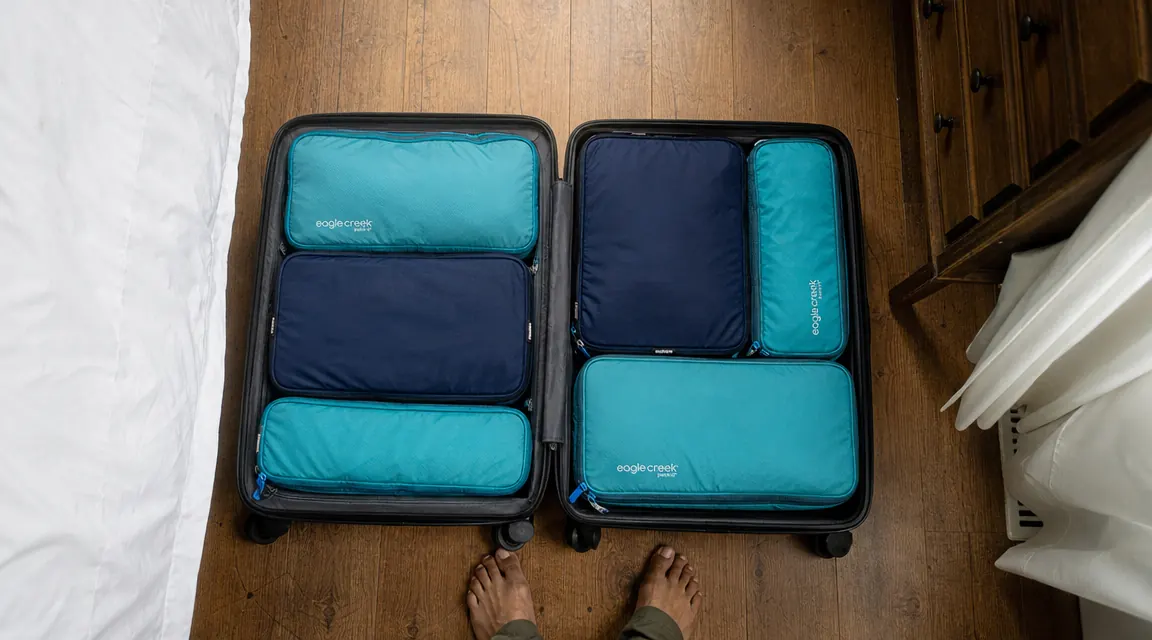
We used to pack for a week like most families do: drag out the big checked bag, toss everything in, and spend the first night at the hotel trying to find pajamas under a pile of someone's jeans. Then we started using the BAGAIL 8-set packing cubes, and the whole routine changed. A week's worth of clothes for two adults now fits in a single carry-on, which means no checked bag fees, no waiting at baggage claim, and no suitcase avalanche the moment someone unzips the lid at the Airbnb.
This guide walks through exactly how we do it, step by step. It works for road trips where you're living out of your bag across multiple stops, and it works just as well for a week-long flight trip where you're committed to carry-on only. The BAGAIL set gives you eight cubes in four sizes, which is just about perfect for mapping to clothing categories. Here is the system we actually use.
Still digging through a messy suitcase at 11pm? This cube set fixes that.
The BAGAIL 8-Set Packing Cubes come in four sizes with 42,000+ reviews and a 4.6-star rating. Under $20 for the full set.
Amazon Check Today's Price on Amazon →What You Need Before You Start
Before walking through the steps, a quick note on what actually makes this system work. You need a carry-on with a hard or semi-structured frame, not a soft duffel. Packing cubes rely on the bag walls to keep their shape. A structured carry-on (most rolling carry-ons 22 inches or under work fine) lets you stack cubes like bricks instead of letting them slide around.
You also need the full 8-set from BAGAIL, not just the large cubes. The smaller cubes are where this system earns its keep. The two extra-small cubes handle underwear and socks. The slim cubes handle accessories and chargers. Without the full range of sizes, you lose the organizational precision that makes a week fit into carry-on space.
Step 1: Lay Out Everything You Think You Need, Then Edit Down
Start by laying out every clothing item you're planning to bring. All of it, on the bed. Tops, bottoms, underwear, socks, pajamas, a light layer, shoes. For a seven-day trip, most people lay out more than they need. The rule we use: seven nights means no more than five tops (three of them can repeat), four bottoms, and one nicer outfit if the trip calls for it. That number sounds tight until you actually see how little space five tops take up when they are rolled and cubed.
Cut anything that requires a matching piece you are not already bringing. Cut the outfit you are packing 'just in case' unless the case has a real name and a real date on it. Edit until what is on the bed is what you would actually wear. Now you are ready to fill the cubes.
Step 2: Assign a Cube to Each Category
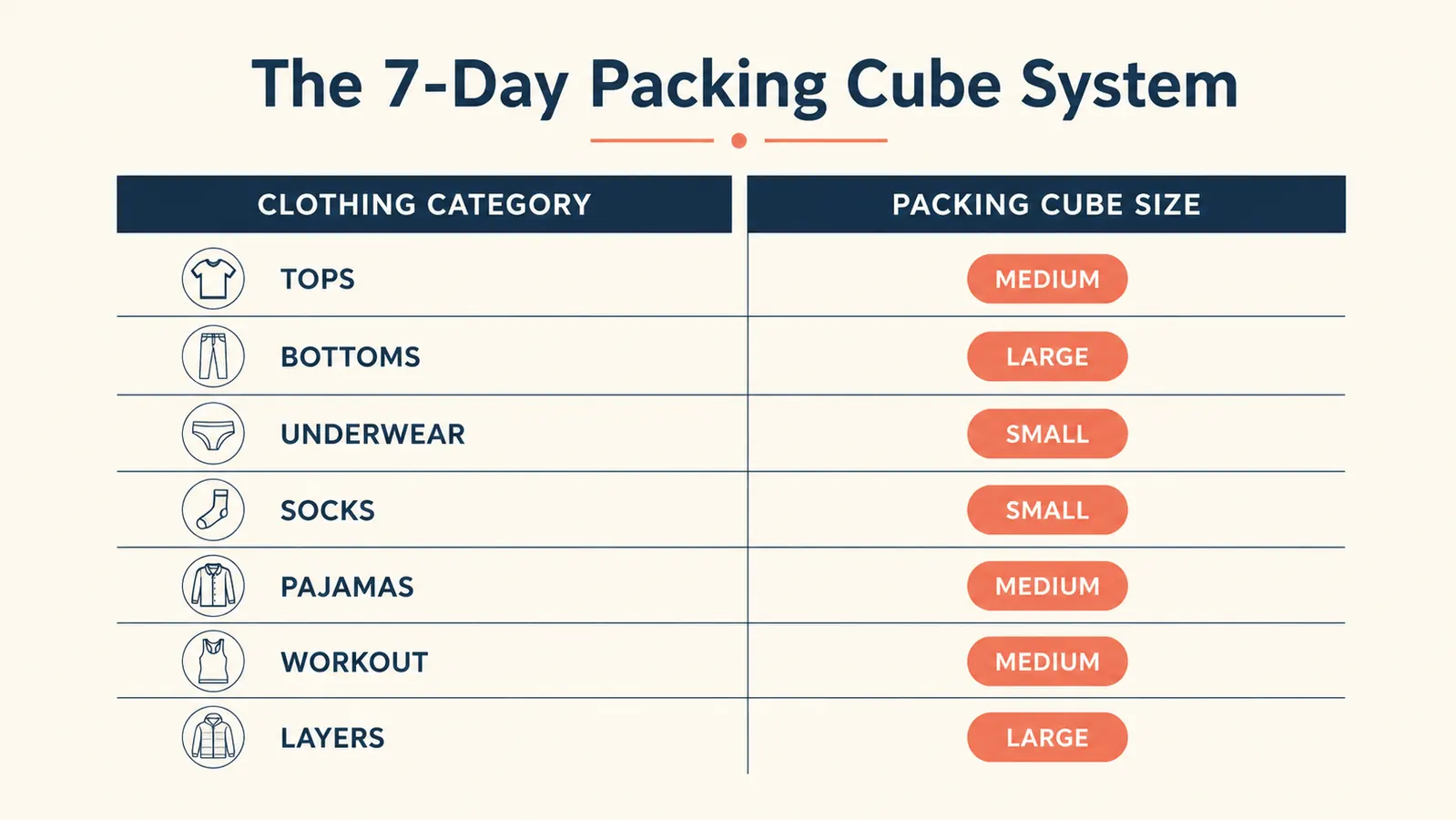
The BAGAIL 8-set includes two large cubes, two medium cubes, two small cubes, and two extra-small cubes. Our assignment for a seven-day solo-adult pack looks like this: one large cube for tops, one large cube for bottoms and pajamas, one medium cube for the spare layer and any swimwear or workout clothes, one small cube for socks, one small cube for underwear, and the extra-small cubes for accessories and any flat or folded items like a scarf or a reusable bag. That accounts for every category.
If you are packing for two, the system shifts slightly. Each person gets their own cubes and their own color-coded set if you use the sets that come in different colors. This matters more than it sounds. Being able to pull out 'the teal cubes' versus 'the navy cubes' means hotel room unpacking takes under two minutes and no one is ever rifling through the other person's clothes at six in the morning.
Step 3: Roll, Don't Fold
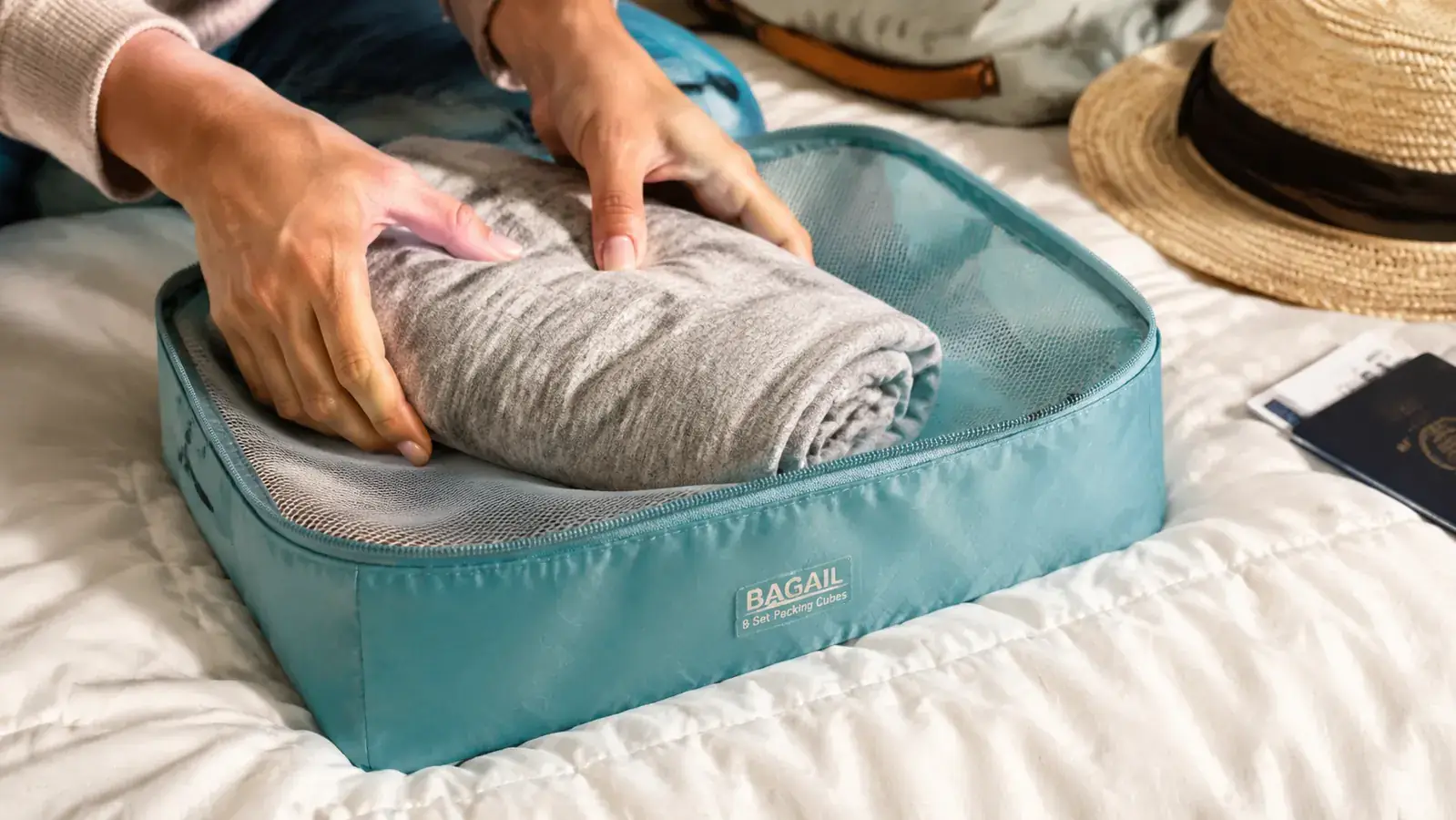
Rolling takes about thirty seconds to learn and it makes a real difference in how much fits. The basic roll: lay the shirt flat, fold the sleeves in across the chest, then roll from the bottom hem up toward the collar as tightly as you can without stretching the fabric. Place the rolls standing upright in the cube, not flat like a stack of pancakes. Standing upright means you can see every item the moment you open the cube, and you can pull one shirt without disturbing the others.
Jeans and thicker bottoms get folded in half lengthwise and then rolled from the waistband down. They will not roll as tightly as a t-shirt, but they compress more than a flat fold and stack much better in the large cube. For dress pants or anything wrinkle-sensitive, the flat fold in a medium cube works better than rolling. Most casual travel clothes handle rolling without any wrinkle issues at all.
Step 4: Fill Each Cube Firmly and Zip It Closed
Once all the items are rolled, load each cube by category. Fill the cube until you can close the zipper with moderate pressure, but not so tightly that the zipper strains. The BAGAIL cubes hold their shape well enough that a properly filled cube feels slightly firm to the touch, like a fat paperback book. That firmness is what lets you stack them and what keeps the carry-on structured.
The extra-small cubes are worth taking seriously. Underwear and socks rolled tightly and loaded into the two small cubes take up a fraction of the space they would otherwise occupy. We were surprised the first time we saw a week of underwear fit into one cube the size of a hardcover novel. It looks impossible until you try it.
A week of underwear fits into one cube the size of a hardcover novel. It looks impossible until you try it.
Step 5: Load the Carry-On in the Right Order
Loading order matters. The cubes you will need first should go on top or toward the exterior zip pocket. Our standard loading order from bottom to top: bottoms and pajamas cube at the base (you will not need those until bedtime), tops cube next, then the layer or swimwear cube, then socks and underwear cubes flat across the top so you can grab them every morning without disturbing the rest. The extra-small accessory cubes go in any gap space or the top exterior pocket.
That is it. When loaded this way, the carry-on lays flat and fully zips without pushing. The outside measures well under 22 inches so it fits in the overhead bin without a fight. When you get to your hotel, you can either pull each cube into a drawer (the cubes become your dresser) or leave them in the bag and treat the bag as the dresser. Either way, nothing is loose, nothing is mixed together, and nothing needs to be re-sorted for the return trip.
What Else Helps
A few additions that make the system run even smoother. A small compression cube works well for the bulkiest items, like a hooded sweatshirt or a fleece, if your trip has a cold night or two built in. Those items do not roll tidily. Putting them in a compression cube lets you squeeze the air out and reduce them to roughly half their normal volume. The BAGAIL set does not include a compression cube, so that is a separate add-on if you need it.
A few neutral-colored clothing pieces stretch the system further. If four of your five tops work with both pairs of bottoms you brought, you have effectively doubled your outfit options without adding any cubes. Dark jeans that can be worn to dinner and a day of sightseeing are worth their weight. A knit dress that packs to the size of a rolled gym shirt and doubles as casual or dressed-up is the kind of piece that makes carry-on-only travel feel easy rather than restrictive.
Toiletries and shoes are separate from this system. Shoes go in a shoe bag at the bottom of the carry-on or in your personal-item tote bag. Toiletries in a hanging organizer go in your personal-item bag completely. Keeping toiletries out of the carry-on means more cube space and no fumbling at security. If you are looking for the toiletry piece of this system, our guide to organizing toiletries for family travel covers that in detail.

A Note on Packing for Two or More
We pack for two adults regularly and sometimes for two kids as well. For two adults carry-on only, we each get our own full 8-set of BAGAIL cubes and our own carry-on. This is the cleaner system rather than trying to split one 8-set across two people. Two sets of BAGAIL cubes at under $20 each means $40 for a packing system that replaces $35 each-way checked bag fees on the first trip.
For kids, the packing cube system scales down naturally. Kids' clothes are smaller. Two medium BAGAIL cubes fit a week of clothes for a child under ten with room to spare. The cubes also help kids stay organized during the trip because they know where their clothes are. Our older one, who is nine, now packs her own cube with no help from us. That alone was worth the price of the set.
If you want more detail on which BAGAIL set holds up best over time and how the zippers wear after dozens of trips, our full BAGAIL packing cubes review covers all of that. And if you are comparing the BAGAIL set to other options before committing, our BAGAIL vs Amazon Essentials comparison breaks down the differences side by side.
Ready to never check a bag again? The BAGAIL 8-set is where to start.
Over 42,000 families have rated this set 4.6 stars. Eight cubes in four sizes for under $20. The system above works best with this set.
Amazon Check Today's Price on Amazon →